

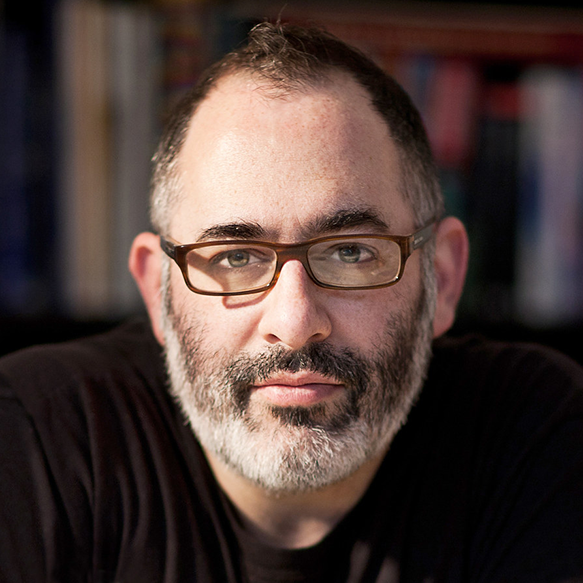
Golan Levin is a Professor of Electronic Art at Carnegie Mellon University, where he encourages students to reclaim computation as a medium of personal expression. Golan's research explores new intersections of machine code and visual culture, combining equal measures of the whimsical, the provocative, and the sublime in a wide variety of media. His work has spanned themes such as the critical potential of digital fabrication; gesture in robotics; novel aesthetics of non-verbal interactivity; and information visualization as a mode of arts practice. Through performances, digital artifacts, and virtual environments, often created with a variety of collaborators, Golan applies creative twists to digital technologies that highlight our relationship with machines, make visible our ways of interacting with each other, and explore the intersection of abstract communication and interactivity. For the past decade, he has sought to nurture improbable directions in new media as Director of CMU's Frank-Ratchye STUDIO for Creative Inquiry, a laboratory for atypical and anti-disciplinary research across the arts, science, technology and culture.
Session
Cultivating the Improbable
For the past 30 years, Golan Levin has worked as an educator, artist, and instigator at the intersection of machine code and visual culture. Since 2009, Golan has also directed CMU's Frank-Ratchye STUDIO for Creative Inquiry, a research laboratory for atypical, anti-disciplinary, and inter-institutional arts research. In this telescopic talk, Golan considers some pasts and futures of emerging media arts: in particular, the perpetual struggle to reclaim computation as a medium of personal expression, and how social sculptures like the STUDIO can operate as strategic improbability incubators for the communities of hybrid oddkins working to address it.